Friday, October 8, 2021

भारतीय वायुसेना दिवस 2021


Indian Air Force Day 2021 (08 October 2021)


भारतीय वायुसेना दिवस 2021


Indian Air Force Day 2021 : देश में हर साल 8 अक्टूबर को भारतीय वायुसेना दिवस (Indian Air Force Day) मनाया जाता है। आज भारतीय वायुसेना अपना 89 वां स्थापना दिवस मना रही है। वायुसेना दिवस के मौके पर शानदार परेड और भव्य एयर शो का आयोजन होता है। हर साल की तरह इस बार भी हिंडन बेस पर वायुसेना अपने शौर्य का प्रदर्शन करेगी। वायुसेना के एक से एक विमान और जवान हवा में हैरतअंगेज करतब दिखाते दिखेंगे। यहां जानें भारतीय वायुसेना दिवस के इतिहास और महत्व के बारे में - 


8 अक्टूबर 1932 को वायुसेना की स्थापना की गई थी इसीलिए हर साल 8 अक्टूबर वायुसेना दिवस मनाया जाता है। देश के स्वतंत्र होने से पहले वायुसेना को रॉयल इंडियन एयर फोर्स (आरआईएएफ) कहा जाता था। 1 अप्रैल 1933 को वायुसेना का पहला दस्ता बना जिसमें 6 आएएफ-ट्रेंड ऑफिसर और 19 हवाई सिपाहियों को शामिल किया गया था। आजादी के बाद वायुसेना के नाम में से "रॉयल" शब्द को हटाकर सिर्फ "इंडियन एयरफोर्स" कर दिया गया था। भारतीय वायुसेना ने द्वितीय विश्वयुद्ध के दौरान भी अहम भूमिका निभाई थी।


आजादी से पहले वायु सेना आर्मी के तहत ही काम करती थी। एयर फोर्स को आर्मी से 'आजाद' करने का श्रेय भारतीय वायु सेना के पहले कमांडर इन चीफ, एयर मार्शल सर थॉमस डब्ल्यू एल्महर्स्ट को जाता है। आजादी के बाद सर थॉमस डब्ल्यू एल्महर्स्ट को भारतीय वायु सेना का पहला चीफ, एयर मार्शल बनाया गया था। वह 15 अगस्त 1947 से 22 फरवरी 1950 तक इस पद पर बने रहे थे।  


गीता से लिया गया है आदर्श वाक्य 

भारतीय वायुसेना का आदर्श वाक्य है- 'नभ: स्पृशं दीप्तम'। यह गीता के 11वें अध्याय से लिया गया है। यह महाभारत के युद्ध के दौरान कुरूक्षेत्र में भगवान श्री कृष्ण द्वारा अर्जुन को दिए गए उपदेश का एक अंश है।


वायुसेना ध्वज


वायुसेना ध्वज, वायु सेना निशान से अलग, नीले रंग का है जिसके शुरुआती एक चौथाई भाग में राष्ट्रीय ध्वज बना है और बीच के हिस्से में राष्ट्रीय ध्वज के तीनों रंगों अर्थात्‌ केसरिया, श्वेत और हरे रंग से बना एक वृत्त (गोलाकार आकृति) है। यह ध्वज 1951 में अपनाया गया। 


Present Air Chief Marshal of India is - Air Chief Marshal Vivek Ram Chaudhari, PVSMAVSM, VM since 30 September 2021

Sunday, October 3, 2021

Lal Bahadur Shastri: The Man of Revolution


The date 2nd October will instantly ring a bell in people who possess an obsessive enthusiasm for our motherland. And, it is the way it should have been because it’s day when India’s greatest statesman Mohandas Karamchand Gandhi and Lal Bahadur Shastri was born. Lal Bahadur Shastri, who later grew up to become the second Prime Minister of India, was born in Uttar Pradesh’s Mughalsarai town.

Here are some of the most interesting facts about  the great personality, who has been posthumously awarded Bharat Ratna:

He was a believer of equality and considered caste system a social evil that creates divide. Therefore, Lal Bahadur Shastri gave up his family name at an early age. It was only after joining the Kashi Vidyapeeth and after getting a degree in Philosophy, he received the epithet ‘Shastri’

Caste system was not the only social evil Lal Bahadur Shastri was fighting against. He also raised his voice against the dowry system and refused to accept anything from his wife’s family at his wedding. It was only after repeated requests from his father-in-law, he took few meters of Khadi cloth as a wedding gift

Taking inspiration from Mohandas Gandhi and Bal Gangadhar Tilak, Lal Bahadur Shastri gave up his studies to join the freedom movement in 1921

 Being a part of the freedom movement landed up him in jail quite often which is why he had to be on parole of 15 days when his daughter fell sick. He was there with her when she succumbed to the disease. But, without waiting any longer and even after having some parole time at hand, he went back to jail soon after performing his daughter’s last rites

After India’s independence, Govind Ballabh Pant took over as the Chief Minister of Uttar Pradesh and he appointed Shastri as the Minister of Police and Transport Control. As the in charge of the transport department, Shastri brought about a meaningful change by appointing women as conductors for the first time. As the in charge of the police department, he replaced the traditional lathis with water jets to put crowds under control. He was also successfully able to control communal riots of 1947

When Shastri was completing his term in prison, his wife received a pension of Rs. 50 every month. Once, when his wife visited him in the jail and told him that she was able to save Rs. 10 from the pension, he got annoyed and asked the Servants of People’s Society to cut down his pension and give that Rs. 10 to someone needy family

When his son received an undue promotion at his job, it irked Lal Bahadur Shastri and he immediately released an order to reverse the promotion

A man with high self-esteem and morals, Shastri did not own a car even after becoming the Prime Minister of India. After pestering from family members, Shastri finally asked his secretary to find out the price of a Fiat car. The cost turned out to be Rs. 12,000 and Shastri was short of Rs. 5000. As a result, he applied for a car loan which was sanctioned to him in a jiffy. The bank officer was immediately summoned and inquired whether the bank was equally swift in sanctioning of loans to other customers also

It’s evident how important principles were to Lal Bahadur Shastri, he always followed the right and wasn’t slightly biased even to his family. We thank him for his actions that shaped the future of India. This exceptional scholar and leader must be remembered dearly by the nation for his efforts and just nature.

Some more information about the Visionary:

Lal Bahadur Shastri’s birth anniversary coincides with Mahatma Gandhi’s birth by whom he was deeply influenced.

His father was a school teacher who passed away when he was just a year and a half old. After the father’s demise, his mother settled at her father’s house with three kids.

He joined his uncle in Varanasi so that he could go to high school. Nanhe, or ‘little one’ as he was called at home used to walk miles to reach school without shoes.

He studied in Kashi Vidya Peeth in Varanasi, one of the many national institutions set up in defiance of the British rule. There, the young leader came under the influence of the greatest intellectuals, and nationalists of the country.

The word ‘Shastri’ in his name was the bachelor’s degree awarded to him by the Vidya Peeth but it got stuck in the minds of the people as part of his name.

At the time of freedom struggle, he led several campaigns and spent a total of seven-year in British jails.

Lal Bahadur Shastri got married to Lalita Devi in 1927.

After the Congress Government was formed in 1946, the young man was being invited to play a constructive role in the governance. The party appointed him Parliamentary Secretary in the State of Uttar Pradesh and soon rose to the position of Home Minister.

He shifted to New Delhi in 1951 and held several portfolios in the Union Cabinet – Minister for Railways; Minister for Transport and Communications; Minister for Commerce and Industry; Home Minister; and during Nehru’s illness Minister without portfolio.

He promoted the White Revolution – a national campaign to increase the production and supply of milk – by supporting the Amul milk co-operative of Anand, Gujarat, and creating the National Dairy Development Board.

Friday, October 1, 2021

Mahatma Gandhi - Father of the nation

Mahatma Gandhi - Father of the Nation 


“When I despair, I remember that all through history the way of truth and love have always won. There have been tyrants and murderers, and for a time, they can seem invincible, but in the end, they always fall. Think of it--always.” - Mahatma Gandhi


Mahatma Gandhi was born on 2 October, 1869 Porbandar, Gujarat. He is the father of the Indian independence movement.

The ideals of Mahatma Gandhi were Ahimsa (non-violence) and Satya (truth). He not only contributed to India's freedom struggle but also inspired people across the world and raise the voice against discrimination of caste, colour, religion. He was a simple man with vast ideas and he always gives a message to others that "Be the change you wish to see in the world".

He pursued law for one year at the University of Bombay and later went to University College London and completed his graduation in 1891. After that, he started working in the Bar Council of England. And also went to South Africa, where he experienced racism.

Mahatma Gandhi's mother tongue was Gujarati.

He did his schooling from Alfred High School, Rajkot.

His birthday (2nd October) is commemorated worldwide as International Day of Nonviolence.

He was the youngest child of his parents. He had 2 brothers and 1 sister.

Gandhi’s father was Hindu by religion and Modh Baniya by caste.

Mahadev Desai was Gandhi’s personal secretary.

Mohandas Karamchand Gandhi was assassinated in the garden of the former Birla House.

Gandhi ji and famous author Leo Tolstoy interacted with each other through letters.

Gandhi ji set up a small colony, Tolstoy Farm at an 1100 acre site, 21 miles from Johannesburg, South Africa for his colleagues in the Satyagraha struggle.

In 1930, he led the Dandi Salt March, and in 1942, he launched the Quit India Movement during the freedom struggle.

He not only fought for Independence but also demanded fair treatment for the untouchables, lower caste, and also done several fasts in support of them. He also called untouchables as Harijans meaning "children of God".

Gandhi in 1982 is an epic historical drama film based on Mohandas Karamchand Gandhi won the Academic Award for the best motion picture.

In 1930, he was the Time Magazine Man of the Year. He was a great writer and the Collected Works of Mahatma Gandhi have 50,000 pages.

Do you know how many times Mahatma Gandhi was nominated for the Nobel Peace Prize? Gandhi ji was nominated in 1937, 1938, 1939, 1947, and, finally, a few days before he was murdered in January 1948.

The country against whom he fought for India's Independence, Great Britain, released a stamp honouring him, 21 years after his death.

Mohandas Karamchand Gandhi was not born with the title Mahatma. He was given the title to him by the Nobel Prize-winning Bengali poet Rabindranath Tagore, according to some authors.

When Jawaharlal Nehru was giving the tryst of destiny speech to celebrate independence, Gandhi ji was not present at that time.

It is said that Mahatma Gandhi's funeral procession was 8 kilometers long.

Reserve Bank of India issued The Gandhi series banknotes by displaying a portrait of Mahatma Gandhi since its introduction in 1996. The series issued in 1996 is of 10 and 500 rupee banknotes.

In 1959, Gandhi Memorial Museum was established. It is located in the city of Madurai in Tamil Nadu, India. It is also known as the Gandhi Museum. It consists of a blood-stained garment which was worn by Mahatma Gandhi when he was assassinated by the Nathuram Godse.


Saturday, September 25, 2021

POSHAN Maah


‘Thematic’ POSHAN Maah To Be Celebrated Across The Nation Throughout The Month Of September As Part Of Azadi Ka Amrit Mahotsav

Weekly Themes To Ensure Focused & Assimilated Approach Towards Improving Holistic Nutrition

Posted On: 29 AUG 2021 11:45AM by PIB Delhi

POSHAN Abhiyaan is Government of India’s flagship programme to improve nutritional outcomes for children, adolescent Girls, pregnant women and lactating mothers. Launched by the Prime Minister Shri Narendra Modi on the occasion of  International Women’s Day on 8 March, 2018 from Jhunjhunu in Rajasthan, the POSHAN (Prime Minister’s Overarching Scheme for Holistic Nutrition) Abhiyaan directs the attention of the country towards the problem of malnutrition and address it in a mission-mode.Focusing on the aims of POSHAN Abhiyaan, Mission Poshan 2.0 (Saksham Anganwadi and Poshan 2.0) has been announced in the Budget 2021-2022 as an integrated nutrition support programme, to strengthen nutritional content, delivery, outreach and outcomes with focus on developing practices that nurture health, wellness and immunity to disease and malnutrition.


POSHAN Abhiyaan is a Jan Andolan or “People’s Movement” byincorporating inclusive participation of public representatives of local bodies, government departments of the States/UTs, social organizations and the public and private sector at large. In order to ensure community mobilization and bolster people’s participation, every year, the month of September is celebrated as POSHAN Maah across the country.


This year, as India celebrates the Azadi Ka Amrit Mahotsav, to ensure speedy& intensive outreach, the entire month has been subdivided into weekly themes for focused and assimilated approach towards improving Holistic Nutrition. The Ministry of Women and Child Development has planned a series of activities throughout the month in tandem with the States/UTs.


The following table highlights the thematic approach being followed this year:


Dates (Weekly)


Theme

Theme 1

1-7 September


Plantation Activity as “PoshanVatika”

Theme 2

8-15 September


Yoga and AYUSH for Nutrition

Theme 3

16-23 September

Distribution of ‘Regional Nutrition Kit’ to Anganwadi beneficiaries of High Burdened Districts


Theme 4

24-30 September

Identification of SAM children and distribution of nutritious food


The wide gamut of activities during the POSHAN Maahthis year will broadly focus on Plantation Drive for POSHAN VATIKA by all the stakeholders in the space available at Anganwadis, School Premises, Gram Panchayats and other places. Plantation activity will focus on planting of saplings of nutritious fruit trees, local vegetables and medicinal plants and herbs. Sensitization/awareness drive for COVID vaccination and Observance of COVID Protocols will also be held.  There will be a special drive for Height and Weight Measurement for Children (under 6 Years of Age) during the PoshanMaah.Slogan writing and Recipe competitions will be organized to highlight the locally available nutritious food for pregnant women. There will be Sessions on “5-minute Yoga Protocol” (Y-break or yoga break) at various workplaces for the employees of Government and corporate bodies, Awareness campaign on importance of  regional / local food, Distribution of Nutrition Kits comprising of regional nutritious food (eg.Sukadi-Gujrat, Panjiri- Punjab, Sattu- Bihar, Chikki- Maharashtra), Anaemia Camps, Drive for block wise Identification of SAM Children, Supervised Supplementary Feeding Program for SAM children as an initiative to tackle prevalence of SAM in children up to the age of 5 years, Sensitisation for Community Management of Acute Malnutrition and Distribution of nutritious food for SAM children.


https://static.pib.gov.in/WriteReadData/userfiles/image/image00183YL.png


During the PoshanMaah, activities related to nutrition awareness will be carried out across all the States/UTs right upto the grass root levels.The implementing departments /agencies like women and child development department through Anganwadi workers, health and family welfare department through ASHA, ANM, primary health centres, community health centres, school education and literacy department through schools, Panchayati Raj departments through panchayats, and rural development trough self-help groups will carry out the activities and spread the message of holistic nutrition throughout the month to ensure a healthier future for women and children.


https://static.pib.gov.in/WriteReadData/userfiles/image/image0023Y10.jpg


Launched with a noble and holistic goal, PoshanAbhiyaan overall intends to increase nutritional awareness and responsiveness among mothers of young children, adolescent girls, pregnant and lactating women, family members including husbands, father, mothers-in-lawand community members, health care providers (ANM, ASHA, Anganwadi worker) about vital nutrition behaviours. The POSHAN Maah intends to achieve the holistic goals of PoshanAbhiyaan with swiftness in a harmonized manner.

Tuesday, June 1, 2021


COUNSELLOR DOST

Do You Need  Career Guidance  Counselling?

Want to Talk about 

Exams, Stress, Anxiety, Depression, Relationship, Behaviour, 

Time Management, Anger Management or CBSE Initiatives?

Our Team of Trained and Dedicated Counsellors,

 Psychologists, Educators and Psychiatrists

is ready to assist you. 

 What's App Chat or 

TALK NOW

Or ask your question here

https://counsellordost.com/

LET'S TALK ABOUT


Adolescence 

Addiction 

Anger

Anxiety

Break Up

Depression

Fear of Failure

Grief & Loss

Healthy & Positive Relationship 

Inferiority Complex

Insomnia

Loneliness

Low Self-Confidence

Obsessivenes

Peer Pressure

Phobia

Stress

Student Life 

Superiority Complex

Trauma

Saturday, May 22, 2021


                                                Raja Rammohan Roy

                                     Born22 May 1772, Radhanagar, Khanakul


Tuesday, April 27, 2021

 Hello Students.

Due to some technical issue, couldn't connect with you for a long time.

Wednesday, December 9, 2020

Celebrating Fit India School week
FIT INDIA Fitness Ka Dose Aadha Ghanta Roz ... 

9th to 16th December, 2020
Fun and Fitness


Celebrating Fit India School week
FIT INDIA Fitness Ka Dose Aadha Ghanta Roz ... 

9th to 16th December, 2020


Wednesday, December 2, 2020

GSP AUDIT

 Students from grade 5-12 can register and participate individually by their own.Last date of submission audit is 11 december 2020. Students to make a week observation at home for completion of different areas of audit as electricity audit ,water audit etc. and inform to the Class teachers, so that Class Teacher have record of no.of participation.

https://greenschoolprogramme.org/audit/Audit@home

link for GSP AUDIT

Last date for audit 11/12/2020

KALA UTSAV COMPETITION - 2020

 Greetings of the day !!!!!


Dear students,


This is to inform you that NCERT is organising a KALA UTSAV COMPETITION - 2020 through online mode and hence has asked to submit entries of students of standard IX to XII in the field of Visual Arts.


You are therefore required to submit your entry/entries in any one or more of the following Art Theme by 09:00 p.m. today as Regional Level Competition will take place on 04-12-2020:


S.No) Art Theme 

👇🏻👇🏻👇🏻👇🏻👇🏻👇🏻


1) Drawing (2-D) 

2) Painting(2-D) 

3) Print

4) Sculpture(3-D) 

5) Traditional Toys & Games


You can send your work on the no. 9870533342 directly via whatsapp.


In case of any query, you can directly contact me(Barkha, TGT - Art Education) on the no. as mentioned above.


Tuesday, December 1, 2020

Acharya Jagadish Chandra Bose


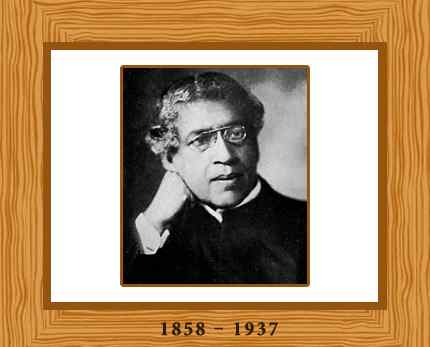
Jagadish Chandra Bose

Jagadish Chandra Bose

Sir Jagadish Chandra Bose is one of the most prominent first Indian scientists who proved by experimentation that both animals and plants share much in common. He demonstrated that plants are also sensitive to heat, cold, light, noise and various other external stimuli. Bose contrived a very sophisticated instrument called the crescograph, which could record and observe plants minute responses to external stimulants. It was capable of magnifying the motion of plant tissues to about 10,000 times of their actual size and, in doing so, found many similarities between plants and other living organisms.

Early Life and Career Path:

Jagadish Chandra Bose was born on 30 November, 1858 at Mymensingh, now in Bangladesh. He was raised in a home committed to pure Indian traditions and culture. He received his elementary education from a vernacular school, because his father believed that Bose should learn his own mother tongue, Bengali, before studying a foreign language like English.

Later he attended St. Xavier’s School at Kolkata and passed the Entrance Examination for Calcutta University.

Bose attended the University of Cambridge studying natural sciences after graduating with a physics degree from Calcutta University. He returned to India in 1884 after completing his B.Sc. degree from Cambridge University and was appointed professor of physical science at Presidency College, Calcutta (now Kolkata).

In 1917 Bose left his professorship and established the Bose Institute at Calcutta which was initially devoted principally to the study of plants. He was its director for twenty years until his death.

Famous Experiment:

The central hall of the Royal Society in London was jam-packed with famous scientists on May 10, 1901. Everyone seemed to be curious to know how Bose’s experiment will demonstrate that plants have feelings like other living beings and humans. Bose chose a plant whose roots were cautiously dipped up to its stem in a vessel holding the bromide solution, which is considered a poison. He plugged in the instrument with the plant and viewed the lighted spot on a screen showing the movements of the plant, as its pulse beat, and the spot began to and fro movement similar to a pendulum. Within minutes, the spot vibrated in a violent manner and finally came to an abrupt stop. The whole thing was almost like a poisoned rat fighting against death. The plant had died due to the exposure to the poisonous bromide solution.

The event was greeted with much appreciation and applause; however some physiologists were not content, and considered Bose as an intruder. They harshly knocked the experiment but Bose did not give up and was confident about his findings.

Using the crescograph, he further researched the response of the plants to fertilizers, light rays and wireless waves. The instrument received widespread acclaim, particularly from the Path Congress of Science in 1900. Many physiologists also supported his findings later on, using more advanced instruments.

Later Life and Death:

Bose authored two illustrious books; ‘Response in the Living and Non-living’ (1902) and ‘The Nervous Mechanism of Plants’ (1926). He also extensively researched the behavior of radio waves. Mostly known as a plant physiologist, he was actually a physicist. Bose made improvements on another instrument called ‘the coherer’, for detecting the radio waves.

He was knighted in 1917 and elected the Fellow of the Royal Society in 1920 for his amazing contributions and achievements. He died aged 78, on 23 November in 1937, in Giridih, India.

Thursday, November 12, 2020

National Book Week Celebration


We are celebrating National Book Week From 7th to 13th November, 2020.

Theme for this year is "Passport To Tomorrow".

Different activities have been designed.

Class 6    Designing a Book Mark and Book Jacket.

Class 7    Slogan writing on Importance of Books.

Class 8   Quotation writing on the Importance of Book.

Class 9     Poster Making on the Importance of Book.

Class 10    Prepare a Power Point Presentation on National Book Week.

Class 11    Prepare a Power Point Presentation on Open Educational Resources.

Class 12    Essay writing on "Virtual Lerning VS Traditional Learning".

National Education Day


Every year, India celebrates National Education Day on November 11 to commemorate the birth anniversary of Maulana Abul Kalam Azad -- the first Union Education Minister of India. A freedom fighter, scholar and eminent educationist, Maulana Azad was a key architect of Independent India who was responsible for setting up apex education bodies like AICTE and UGC. On National Education Day, India remembers Maulana Azad’s contributions to nation-building.

The Central Government, with a resolution on September 11, 2008, declared November 11 as National Education Day.

The first National Education Day celebrations were inaugurated by then President of India Pratibha Patil on November 11, 2008 at Vigyan Bhawan, New Delhi.

Maulana Azad "laid the base for higher education and for technological and scientific research and education that was instrumental in industrialisation and the recent emergence of knowledge-based industries".

The first Indian Institute of Technology, IIT Kharagpur, was established by Maulana Abul Kalam Azad.

Maulana Azad once said that Schools are laboratories that produce future citizens of the country. In his address to the first meeting of the Central Advisory Board of Education (CABE), Maulana Azad said: "The primary aim of any system is to create balanced minds which cannot be misled."

Apart from IIT Kharagpur, University Grants Commission (UGC), All India Council For Technical Education, Maulana Abul Kalam Azad was also responsible for setting up Indian Council for Cultural Relations (ICCR), Sahitya Academy, Lalit Kala Academy, Sangeet Natak Academy and Council of Scientific and Industrial Research (CSIR).

Maulana Azad was posthumously awarded Bharat Ratna -- India’s highest civilian award -- in 1992.